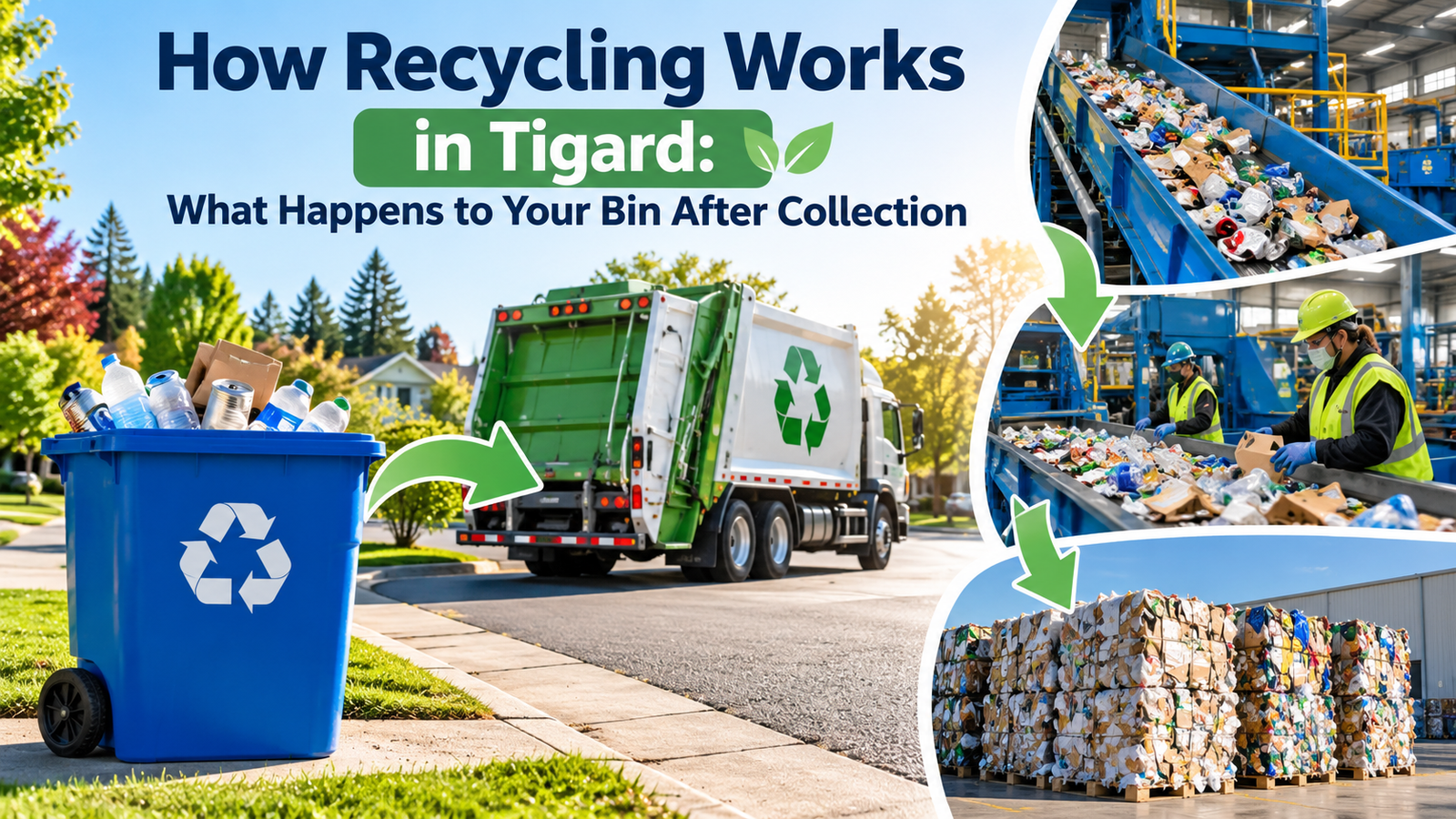
Every week, thousands of households in Tigard roll a blue cart to the curb and trust that its contents will become something useful. For most people the story ends when the truck turns the corner. In reality, that is where one of the more interesting parts of the process begins. A bale of cardboard from a Tigard kitchen may end up as a shipping box in a few weeks. A steel can may be melted into rebar. A bottle may be crushed, melted, and blown into a new bottle without ever losing its basic properties.
This article follows that journey from the curb to the finished product. It explains how Recycling Service Tigard is organized in the Portland metropolitan area, what the sorting plant actually does, why contamination is the main enemy of the whole system, and how Oregon’s recent changes to recycling law are reshaping what goes in the bin. It also covers the items that need a different path altogether and the local conditions in Tigard that make recycling a little different here than in a drier or less wooded place.
Why Recycling Is Organized the Way It Is
Recycling is not a single activity but a chain of linked steps. Material has to be collected, sorted, cleaned, baled, sold, and manufactured into something new. If any link breaks, the whole chain slows down. A paper mill that cannot get clean paper will shut down a line. A sorting plant that receives too much trash will pay to landfill it. A household that puts the wrong item in the bin creates a problem that travels all the way along the chain.
That is why recycling programs spend so much effort on simple rules. The rules are not arbitrary. They reflect what the sorting equipment can physically handle and what the buyers of recovered material will actually accept. A rule that seems fussy, like keeping plastic bags out of the cart, usually has a mechanical reason behind it.
The Regional Framework Around Tigard
Tigard sits in Washington County, in the southwest part of the Portland metropolitan area. Waste and recycling here are shaped by several layers of government working together.
At the state level, Oregon’s Department of Environmental Quality oversees solid waste and recycling policy. Oregon has a long record of leadership in this field, including the nation’s first bottle deposit law in 1971 and a statewide recycling opportunity law passed in 1983 that required most communities to offer curbside collection.
At the regional level, Metro, the elected regional government for the Portland area, plans waste reduction, regulates certain facilities, and runs household hazardous waste services. Metro also sets rules about what kinds of material must go through facilities that recover reusable components, which affects how construction debris and mixed waste are handled.
At the local level, the city and county grant collection franchises to haulers, set service standards, and publish the list of materials that are accepted in curbside carts. The hauler serving a given address collects the material and delivers it to a sorting facility. Residents are best served by checking the current local list, because accepted materials have changed over the years and continue to change.
What Goes in the Curbside Cart
Programs in the Portland area have traditionally asked residents to place a consistent set of items in the recycling cart. The exact list can shift, but the core categories tend to be stable.
| Material | Generally accepted | Commonly causes problems |
|---|---|---|
| Paper | Office paper, newspaper, magazines, junk mail, paper bags | Shredded paper in loose form, waxed or foil-lined paper, used tissues |
| Cardboard | Flattened boxes, paperboard such as cereal and cracker boxes | Greasy pizza boxes, wet or moldy cardboard |
| Metal | Steel and aluminum food cans, clean foil in a ball | Paint cans with wet paint, aerosol cans that are not empty |
| Plastic | Bottles, jugs, and tubs with lids on or off depending on local rules | Plastic bags, film, foam, black plastic trays |
| Glass | Often handled separately through deposit returns or depots | Broken glass mixed with paper, drinking glasses, ceramics |
The most important single habit is to place items loose in the cart. Bagging recyclables in a plastic bag before putting them in the bin is one of the most common mistakes, because the sorting plant cannot open the bags and the whole bagged load may be treated as trash.
Inside the Sorting Facility
A materials recovery facility, often called a MRF and pronounced like the word “smurf” without the first letter, is where mixed recyclables are turned into sorted commodities. The process is a mix of machinery and human attention.
First, trucks tip their loads onto a large floor. Workers and equipment push material onto a conveyor, and the first job is to pull out items that obviously do not belong, such as garden hoses, textiles, and large pieces of plastic that could wrap around gears.
Next comes mechanical separation. Rotating disc screens bounce flat items like paper and cardboard upward and let smaller, heavier items such as containers fall through. This divides the stream into flat fibers and three-dimensional containers.
Magnets then lift steel cans out of the stream. Further along, an eddy current separator uses a rapidly changing magnetic field to repel aluminum, flinging cans off the belt into their own bin.
Optical sorters use near-infrared light to identify different types of plastic. When the sensor recognizes a particular resin, a short burst of air knocks the item off the belt into a separate chute. This is how clear bottles, milk jugs, and colored containers are separated by type.
Finally, people stand along the line and remove whatever the machines missed. Their work is demanding, and it is made harder every time a hazardous or oversized item appears on the belt.
At the end of the line, each sorted material is compressed into dense bales. A bale of aluminum cans, a bale of cardboard, and a bale of plastic bottles are sold to manufacturers or to brokers who supply them. The quality of each bale determines its value, and a contaminated bale can be rejected entirely.
What Each Material Becomes
The most satisfying part of the story is where the material ends up.
Paper and cardboard. Fibers are mixed with water at a paper mill into a slurry, cleaned of staples and tape, and pressed into new sheets. Paper fibers can be recycled several times before they become too short to hold together. Recovered cardboard becomes new boxes, paperboard, and tissue products.
Steel. Steel cans are shredded and melted in furnaces with other scrap. Steel is one of the most recycled materials in the world, and it can be recycled repeatedly without losing its strength.
Aluminum. Aluminum cans are melted and rolled into new sheet metal. Because recycling aluminum uses a small fraction of the energy needed to make it from raw ore, it is among the most valuable materials in the bin.
Plastic. Bottles and jugs are washed, ground into flakes, melted, and formed into pellets that become new bottles, carpet fiber, clothing fleece, and containers. Not all plastics are equally recyclable, which is why local programs focus on bottles, jugs, and tubs rather than every plastic item.
Glass. Glass can be melted and reformed into new bottles and jars almost indefinitely. Clean, color-sorted glass is particularly valuable, which is one reason Oregon encourages returning deposit bottles and using dedicated glass collection rather than mixing glass with other materials.
Contamination: The Biggest Challenge
Contamination means anything in the recycling stream that does not belong there. It includes obvious trash, food residue, liquids, and items that are recyclable in principle but not accepted locally. It is the single biggest threat to the economics of recycling.
A few examples show how it works. A half-full yogurt container can leak onto a pile of paper and make it unsellable. A garden hose can jam a screen and shut down a line. A single lithium battery that is crushed in a truck can start a fire. A plastic bag can wrap around a rotating shaft and require workers to stop the machinery and cut it free.
The industry guidance is simple. Empty, rinse lightly, and keep dry. Containers do not need to be spotless, but they should be free of loose food. Paper should be dry, because wet paper loses fiber strength and can mold. And when in doubt about a specific item, the better choice is usually to leave it out, because an uncertain item that turns out to be contamination does more harm than the same item in the trash.
Oregon’s Recycling Modernization Act
Oregon has been rebuilding parts of its recycling system under the Recycling Modernization Act, passed in 2021. The law shifts some of the responsibility for packaging waste toward the producers who create the packaging. It also moves the state toward a more uniform statewide list of materials collected at the curb, so that a resident in one town and a resident in another town follow similar rules.
Another goal of the law is to improve access to recycling for people who live in apartments or rural areas, and to build a network of depots for materials that do not fit well in curbside programs. The details of implementation continue to roll out in stages, which is why the accepted-materials list can change and why checking current guidance matters.
For residents, the practical effect is that the system is gradually becoming more consistent, with clearer labeling and more places to take items that are not accepted at the curb.
Items That Need a Different Path
Some everyday items should never go in the curbside cart, no matter how recyclable they are in principle.
- Electronics. Oregon’s E-Cycles program provides free recycling for computers, monitors, laptops, tablets, printers, and televisions through registered collection sites.
- Batteries. Household batteries, and lithium batteries in particular, belong at collection points. Damaged lithium batteries are a fire hazard in trucks and sorting facilities.
- Paint. Leftover paint is collected through the PaintCare program at participating retailers and drop-off sites.
- Mattresses. Oregon has a stewardship program for mattresses, which are broken down into steel, foam, and fabric.
- Fluorescent and compact fluorescent bulbs. These contain small amounts of mercury and need separate collection.
- Foam packaging and film plastics. These are generally not accepted curbside, but some retailers and depots take clean film and specific foam products.
- Household hazardous waste. Solvents, pesticides, pool chemicals, and similar products go to hazardous waste facilities or collection events rather than the cart.
Keeping these items out of the bin protects collection workers and keeps the stream clean enough to sell.
Local Conditions in Tigard That Affect Recycling
Tigard is a suburban city with a mix of single-family neighborhoods, townhomes, apartment complexes, and commercial districts along Highway 99W, Pacific Highway, and around Washington Square. A few local conditions shape how recycling plays out.
Rain. Western Oregon’s wet season means that cardboard left outdoors can soak through quickly. Wet cardboard weighs more, loses fiber quality, and can contaminate other paper in a cart. Flattening boxes, keeping carts closed, and holding extra cardboard indoors until collection day helps.
Tree cover and yard debris. Tigard has many mature trees, and fall leaf drop is heavy. Leaves, branches, and other yard material belong in the yard debris stream rather than the recycling cart. Mixing them creates contamination and adds weight.
Multifamily housing. Apartments and condominiums often use shared containers, which makes contamination more common because no single household owns the cart. Clear signage and consistent rules help, and many programs have invested in education for multifamily properties.
Creek and watershed protection. Fanno Creek and the Tualatin River watershed are important local waterways. Litter and improperly discarded materials that escape from carts can reach storm drains and flow into creeks. Keeping lids closed on windy days and bringing carts in after collection helps prevent that.
Wind and wildlife. Open carts in windy weather scatter paper and plastic, and crows and raccoons are known to investigate food-soiled containers. Rinsing containers reduces both problems.
Commercial recycling. Businesses in the Tigard area generate large volumes of cardboard, pallets, and packaging. Metro and the state have rules aimed at helping commercial customers separate recyclable materials, and many businesses use dedicated cardboard and mixed paper services.
Common Misunderstandings
“Recycling is just a feel-good gesture.” Recycling saves significant energy and raw materials, especially for aluminum, steel, and paper. The benefits depend on good sorting, which is why the details matter.
“If it has a recycling symbol, it goes in the cart.” The triangle with a number on plastic items identifies the resin type, not whether the item is accepted locally. Many numbered plastics are not collected at the curb.
“Washing everything thoroughly is required.” A quick rinse is usually enough. Perfectly clean containers waste water, and the goal is to remove loose food rather than every trace.
“Putting questionable items in the cart cannot hurt.” Wishcycling lowers the quality of bales and can create hazards. It is better to follow the local list.
“Everything gets shipped overseas.” Much of the material from the Pacific Northwest is processed domestically or sold in regional markets, though global commodity markets influence what is sold where.
Simple Habits That Make Recycling Work Better
- Keep items loose in the cart, not bagged.
- Flatten cardboard boxes and keep them dry.
- Empty and lightly rinse food containers.
- Check the local accepted-materials list before adding unusual items.
- Take electronics, batteries, paint, and bulbs to proper collection points.
- Return deposit bottles and cans through the bottle redemption system.
- Keep yard debris and food scraps in their own carts where offered.
- Close the lid and bring the cart in after collection.
Frequently Asked Questions
What happens to recycling after it is collected in Tigard?
The truck delivers it to a materials recovery facility, where it is sorted by machines and workers into paper, cardboard, metal, and plastic. Each material is baled and sold to manufacturers that turn it into new products.
Why are plastic bags not allowed in the curbside cart?
Bags wrap around the rotating screens and shafts at the sorting facility and cause shutdowns. Many grocery stores collect clean plastic bags separately.
Do I need to wash recyclables?
A light rinse to remove loose food is enough. Containers do not need to be spotless, but they should not contain liquids or heavy residue.
Can I recycle pizza boxes?
Boxes with heavy grease or cheese are usually considered contaminated. Clean parts of the box can sometimes be torn off and recycled, while greasy parts go in the trash or compost where accepted.
Why is glass handled differently?
Broken glass can contaminate paper and damage equipment, and glass is more valuable when it is sorted by color. Many Oregon programs encourage returning deposit bottles and using separate glass collection.
What should I do with old electronics?
Take them to a registered E-Cycles collection site. Oregon’s program provides free recycling for computers, monitors, laptops, tablets, printers, and televisions.
Are batteries recyclable?
Yes, but they should not go in the curbside cart. Household batteries and rechargeable batteries have collection points at many retailers and hazardous waste facilities.
How does rain affect recycling in Western Oregon?
Wet paper and cardboard lose fiber quality and can contaminate other materials. Keeping boxes flattened and dry and keeping the cart lid closed reduces the problem.
Final Thoughts
Recycling works when each person in the chain does a small part well. Households sort carefully, trucks collect cleanly, facilities separate precisely, and manufacturers turn the recovered materials into new products. The system is more mechanical and more sensitive than most people realize, which is why simple rules and consistent habits matter so much.
For anyone trying to understand how a recycling service in Tigard fits into the larger regional and state system, the key ideas are straightforward. Know what is accepted locally, keep contamination out, use the special programs for electronics, paint, batteries, and mattresses, and remember that every clean, dry, correctly sorted item makes the next step in the chain easier. Over time, those small choices add up to cleaner streams, stronger markets for recovered materials, and fewer resources taken from the ground.